

Structured Authority develops through deliberate structure, reinforcement, and time.
Most experienced attorneys already possess deep knowledge in their practice area. The challenge is not expertise. The challenge is making that expertise visible in a way that modern discovery systems — including search engines, referral networks, artificial intelligence platforms, and AI-assisted answers — can clearly recognize.
What structural elements already exist? What authority signals and content are missing?
Structured Authority is built deliberately through organization, reinforcement, and consistency over time.
This is not a short-term campaign. It is a structured development process that gradually strengthens how a firm’s expertise is recognized.
Authority develops over time, but recognition can be accelerated when the architecture, content, and signals are deliberately and consistently built.

Structured Authority develops through a deliberate process that organizes and reinforces a firm’s expertise over time.
Rather than publishing isolated content or disconnected articles, the objective is to build a structured framework that allows expertise to be recognized consistently across modern discovery systems.
Structured Authority develops through a repeatable framework:
The framework unfolds through five stages.
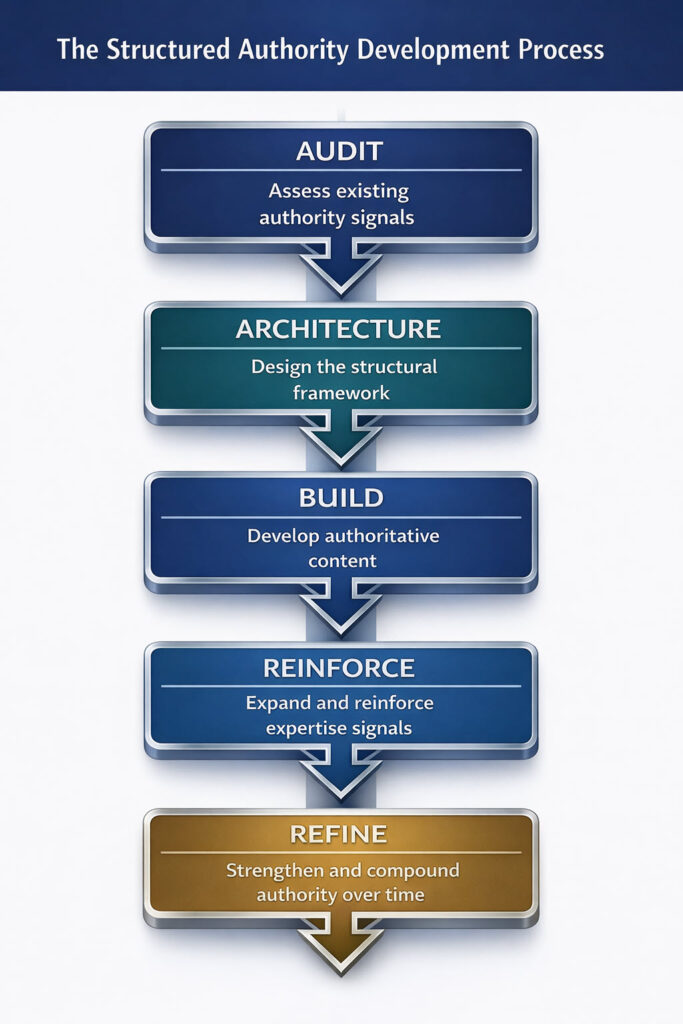
Each stage strengthens the signals that allow search engines, referral networks, and AI-assisted discovery systems to recognize patterns of expertise.
While the stages are presented sequentially, in practice they often overlap as the authority structure becomes clearer and more refined.
We begin by evaluating the firm’s existing authority signals.
This includes reviewing the current website structure, practice area coverage, internal linking patterns, and the topics that already generate visibility or inquiries.
The goal is to understand which signals already exist and where the authority structure needs strengthening.
This stage often reveals that valuable expertise is already present but has not yet been organized in a way that discovery systems clearly recognize.

Once the audit is complete, we design the structural framework that will organize the firm’s expertise.
This typically involves defining:
- pillar pages for primary practice areas
- supporting topic clusters
- internal linking architecture
- structured data signals that clarify subject relationships
Rather than publishing disconnected articles, the firm’s knowledge is organized into a clear and deliberate system.
Over time, this structure allows individual pieces of content to reinforce one another.

With the architecture in place, we begin developing authoritative content that addresses the real issues clients encounter.
This may include:
- authoritative practice area pages
- supporting educational resources
- explanatory diagrams and visual resources
- structured content designed to reinforce topical expertise
The emphasis is always on clarity and usefulness rather than promotional language.
Clients searching for legal guidance are typically facing uncertainty. Content that explains processes and consequences clearly tends to carry more weight than marketing messages.

Recognition strengthens when expertise appears consistently across multiple information environments.
Reinforcement may include:
- expanded topical coverage within practice areas
- diagrams and explanatory resources
- multimedia signals such as podcasts or video explanations
- structured content clusters that deepen subject coverage
As these signals accumulate, discovery systems begin to recognize consistent patterns of expertise.

As the structure matures, we continue refining the framework.
This includes strengthening relationships among topics, expanding related subject areas, and reinforcing the signals that search engines and AI-assisted systems rely on when identifying authoritative sources.
Authority rarely appears suddenly. It develops as expertise becomes increasingly organized and reinforced.
Deliberate structure allows that recognition to compound over time.
How Authority Develops Over Time
Authority rarely appears immediately. Recognition strengthens as expertise becomes organized, reinforced, and expanded across multiple signals over time. While each practice and market moves at its own pace, most authority development follows a predictable progression.

Phase 1 — Foundation (0–6 Months)

The first phase focuses on building the structural foundation.
This includes establishing the authority architecture, developing core pillar pages, and creating the initial reinforcement signals that help discovery systems understand how the firm’s expertise is organized.
Early movement often appears as the structure becomes clearer.
Phase 2 — Reinforcement (6–18 Months)
 During the second phase, the topical structure deepens, and the authority signals become more consistent.
Additional resources strengthen subject coverage around the firm’s primary practice areas. Multimedia reinforcement and explanatory resources strengthen the signals that support discovery.
This is often when AI-assisted answers and search results begin referencing structured content more frequently.
Phase 3 — Authority Compounding (18–36 Months)

As the structure matures, authority signals begin to compound.
Practice area clusters become more complete, reputation signals strengthen, and the firm’s expertise becomes easier for discovery systems to recognize and reference.
Visibility often stabilizes and continues strengthening as the structure expands.
Structure determines how quickly expertise becomes visible.
This is not a ninety-day spike in activity. It is a structured authority development process that compounds over time.
That said, measurable progress usually becomes visible along the way.
What Firms Typically Begin to Notice
As the structure strengthens, firms often begin to notice practical changes in how their expertise is recognized.
These changes do not usually appear all at once. They emerge gradually as authority signals become clearer across the site, within topical clusters, and across modern discovery systems.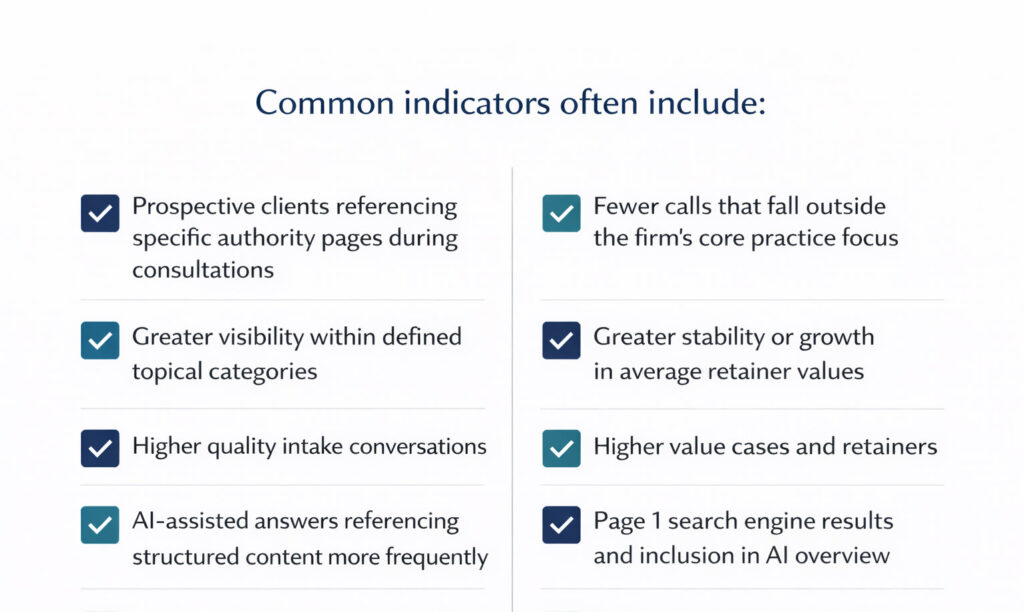
These are not isolated marketing metrics. They are operational signs that the market is beginning to recognize the firm’s expertise more clearly.
Recognition often becomes visible before it becomes obvious.
 In many cases, the earliest signs are subtle.
A prospective client may reference an article that clearly explains a complex issue. A referral source may begin treating the firm’s content as a useful resource. Search visibility may begin to strengthen around specific categories before broader gains become apparent.
Over time, these smaller signals often become part of a larger pattern.
That pattern is what authority looks like as it begins to take hold.