
The Authority Sequence
How Legal Experience and Skill Are Evaluated Before a Decision Is Made
Legal experience and skill are not evaluated all at once. They are processed in a sequence. If that sequence is not supported, the evaluation stops—regardless of the quality of the underlying work.
This sequence determines whether a firm is considered at the moment a decision is made.
The Sequence
Find → Understand → Trust → Connect
Each stage builds on the one before it.
If any stage fails, the process stops.
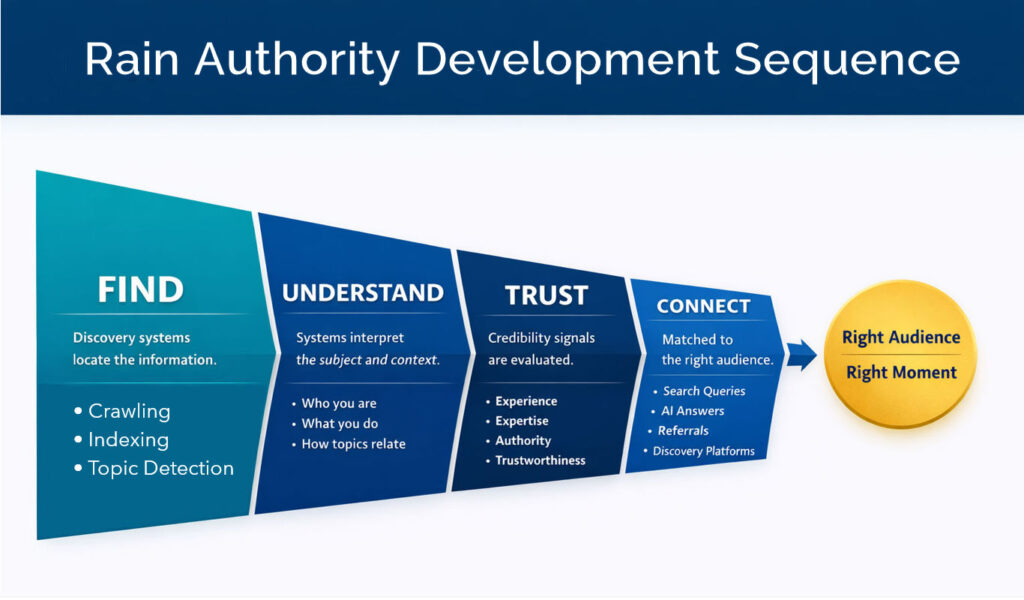
If a firm is not present and interpretable within the environments people use to search, evaluate, and decide, it does not enter the decision process.
Find
The Firm Must Be Discoverable
This includes:
- search engines
- AI-driven answer systems
- professional referral networks
- industry and platform-based discovery environments
At this stage, systems identify:
- that the firm exists
- that it is associated with a topic
- that it may be relevant to a query or situation
If a firm is not found, the process does not begin.
Understand
The System Must Be Able to Interpret What the Firm Does
Being found is not enough. The system must be able to interpret:
- who the firm represents
- what types of matters it handles
- how related issues connect
- the scope and structure of its work
This requires:
- consistent language
- connected content
- clearly defined topics
- structured relationships across pages
If the system cannot form a complete and reliable understanding, the process stops here.
Trust
Credibility Must Be Established Before Evaluation Continues
Once understanding forms, the system evaluates credibility.
This includes signals such as:
- demonstrated experience and legal skill
- consistency across content and messaging
- alignment between claims and supporting material
- presence across recognized platforms and sources
Trust is not assumed.
It is assessed.
If credibility signals are unclear, inconsistent, or incomplete, the process stalls.
Connect
The Firm Is Matched to the Right Situation
Only after trust is established does connection occur.
At this stage, the firm is:
- presented within search results or AI-generated answers
- recommended within referral pathways
- considered by a prospective client evaluating their position
This is where visibility becomes meaningful.
Connection is not exposure.
It is selection.
Where the Sequence Breaks
The sequence does not fail randomly. It fails at specific points.
- If a firm is not found, the process never begins
- If the firm is found but not understood, evaluation stops
- If understanding forms but trust does not, the firm is not selected
Each stage depends on the one before it. Progression is not assumed. It must be established, step by step.
How This Relates to Structure
The sequence is not controlled by tactics.
It is controlled by structure.
- Structural Visibility supports understanding
- Fragmentation prevents understanding from forming
- Timing Advantage is whether a firm’s information is prepared, structured, and interpretable before demand appears
Without structure, the sequence cannot progress reliably.
Why This Matters
Most firms focus on visibility.
Visibility only affects the first stage.
If the sequence breaks at understanding or trust, increased visibility does not improve outcomes.
The issue is not exposure.
It is guided progression.
Each step of the sequence must be intentionally structured so the process is guided forward toward a decision.
A Clear Outcome
When the sequence is intentionally structured:
- the firm is consistently found
- its work is clearly understood and valued
- credibility is established
- and it is connected to the right opportunities
This is not a single event.
It is a repeatable process.