
How Does a Potential Client Move from Where they Stand to the Decision to Hire an Attorney?
 This is the crucial question most legal websites never consider, and certainly don’t answer. It isn’t a process of searching through and ingesting volumes of information until the light bulb in their mind says “Oh, I understand. I need an attorney.”
In fact, the experience of most legal websites is a high-speed collision between a person in need and walls of unstructred legal diatribe.
They aren’t informed. They aren’t guided. In many cases, they simply become overwhelmed or frustrated, and bounce. When a visitor leaves your site, they aren’t just hitting the “back” button or closing a browser window, they are retreating from an environment that failed to provide the ability to comprehend where they stood, what they needed to know, and the steps they should consider to solve their problem.
This is not “funnel” problem – the wrong visitor brought to the wrong page based on their original search. It’s usually not that the site is poorly designed from a visual perspective.
It is a failure to connect with that human visitor where they are.
It is not a funnel issue. It is an architectural issue.
How Does the Decision Standard Affect the Person Visiting the Website of a Law Practice?
 The Decision Standard is rooted in behavioral anchoring. It utilizes an information architecture designed to interrupt the cycle of passive browsing and engage the visitor’s critical evaluation. This methodology guides the individual from initial discovery through a structured process of insight, resulting in a state of genuine awareness and alignment.
It is also what allows your website to avoid the “Visibility Paradox.” Did it ever occur to you that being “visible” is not just an opportunity, it is also a potential risk?
The Visibility Paradox
What could possibly be a risk when one is “visible” in this context? The visibility risk is this: the visitor hits a wall of information structured around small topics – pieces of the puzzle – limited in scope, and designed to perform in search engines.
They don’t experience relief. They don’t see the “answer” to their matter of consequence. In fact, usually the result of their experience is either more questions, or frustration with the lack of genuine insight into their own situation.
As an attorney, you know most risk isn’t faced or managed in a courtroom. In fact, some of the greatest areas of risk for the potential client are the result of their initial interpretations of the events surrounding them, and their resulting actions or inaction.
A bounce occurs when a page fails to provide the standard a visitor can use to begin to understand the crisis or matter of consequence they face. Without an effective integrated decision standard to guide them, the visitor is left in a state of “Information Collision”—possessing facts but lacking the framework to interpret them.
Visibility merely buys the visit. The Decision Standard honors it. By providing a structured path from where the visitor is to where they need to be, we replace the risk of guesswork or the “Information Collision” with the clarity of Alignment.
When a visitor bounces from your website, it is not a funnel issue. It isn’t “they simply aren’t ready. They’ll be back.” It isn’t because the System brought the wrong potential visitor to your page.
It is the failure of most websites to:
- interrupt the “browsing” mind
- engage the visitor and guide them from where they are to a deeper level of understanding
- to provide a level of reassurance that it is possible to manage the issue(s) at hand
- to share the risks of specific actions or inaction
- to move the visitor from where they are in the process – from confusion to a point of clarity
This information risk is a failure of structure. The resulting liability: the visitor clicks away, and moves on to another legal website.
What the Decision Standard Means
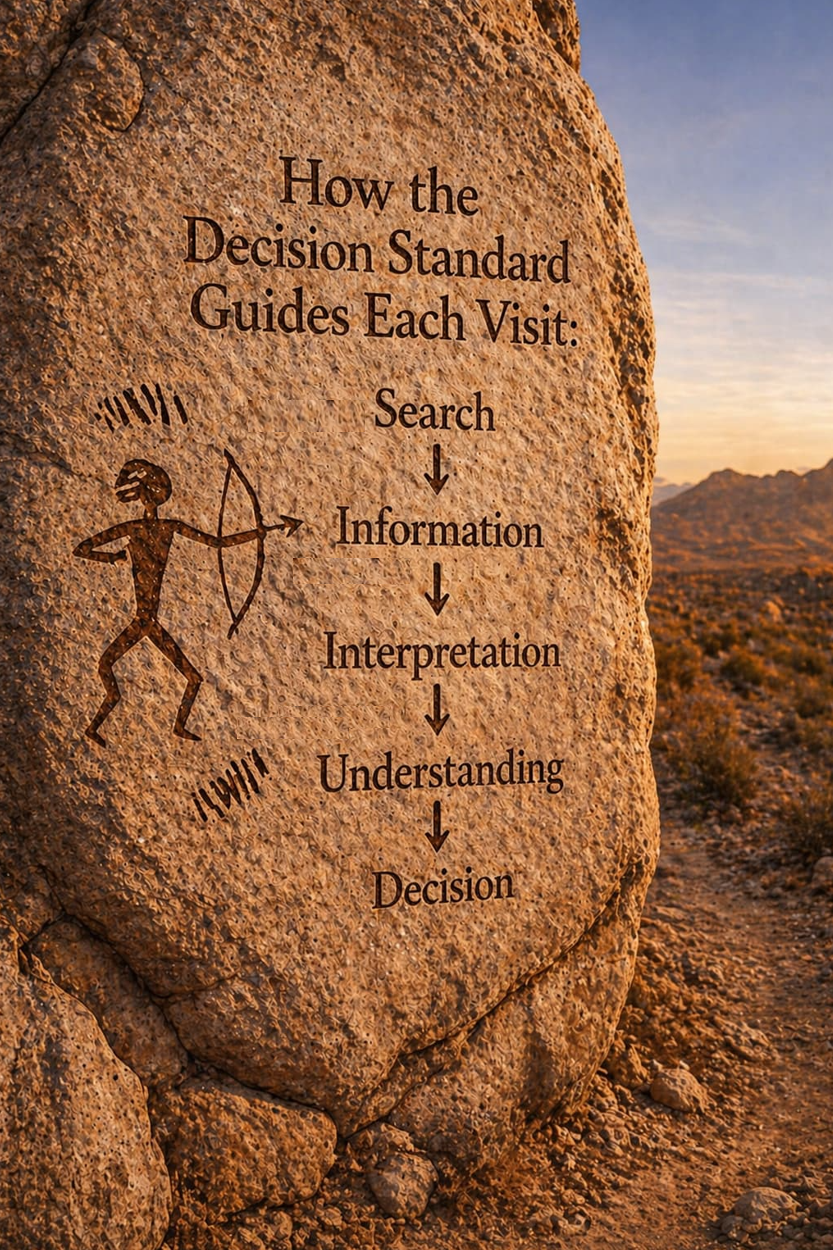
The Decision Standard is the framework a person uses—often without realizing it—to evaluate attorneys and choose representation.
It determines what information is noticed, what signals are trusted, and how a final decision is made.
In most cases, this framework is not deliberate.
It is formed in real time as the visitor searches, reads, compares, and attempts to understand their situation.
 Why This Matters
If left unstructured, the decision standard defaults to what is visible, not what is meaningful.
That leads to:
- incomplete understanding
- misplaced confidence
- early decisions made without clarity
What Actually Changes
The decision standard does not have to be left to chance.
It can be built—intentionally.
Every page, section, and signal on a site can be structured to:
- meet the visitor where they are
- guide how they interpret information
- clarify their position
- shape how they evaluate what they are seeing
This is not content for visibility.
It is structure to provide and guide interpretation.
What This Means in Practice
A properly structured site does not simply present information.
It must:
- organize complexity into usable understanding
- guide how the visitor interprets their situation
- clarify risk, where the visitor actually is in the process, and what comes next
- remove reliance on guesswork and surface signals
As that happens, the visitor’s decision standard improves.
They begin to:
- recognize where they are in the process, and what they need to understand
- identify what actually matters when selecting an attorney
- ask more precise questions
- evaluate attorneys with greater clarity
Why Decision Standard Matters in Legal Matters of Consequence
In legal matters with genuine and significant potential consequences, decisions are often made before the full situation is understood.
That matters because early assumptions shape strategy, expectations, and risk tolerance.
When the decision standard is incomplete, those assumptions are built on unstable ground.
Where the Risk Actually Occurs
The risk is not only in the legal issue itself. It is in how the situation is interpreted by a potential client at the outset.
When interpretation is unclear:
- exposure is underestimated
- leverage is missed
- timing decisions are delayed or misjudged
These are not legal errors.
They are decision errors.
Their Decision Standard costs them the opportunity to work with you – the right attorney for the situation they are facing – and costs you the opportunity to engage a new client.

Why Visibility Alone Fails
Most legal websites are built to be found by search engines. They are not built to be understood, interpreted, or acted upon by the person searching.
As a result:
- information is presented, but not structured
- answers are available, but not connected
- the visitor is left to assemble meaning on their own
In matters of consequence, that gap is where risk enters. In the present information ecosystem, it is where potential clients are lost.
What Changes When the Decision Standard Is Correct

When the decision standard is structured and guided:
- the visitor understands their position earlier
- risk is identified before it compounds
- meaningful distinctions between attorneys become clear
- decisions are made with informed direction, not assumption
This does not simplify the legal matter they are facing.
An effectively integrated Decision Standard clarifies it.
Structured Authority Determines What Happens Next
At this level, the question is no longer whether information is available.
The question is whether the information on your site is structured in a way that allows it to be understood, trusted, and acted upon by a potential client.
That is the function of Structured Authority.
And it is the foundation of what comes next.