
Timing Advantage
Why Structure Must Exist Before the Moment of Demand
Legal experience and skill are not evaluated when they are created. They are evaluated when they are needed. If structure is not in place at that moment, it cannot be applied in time to influence the outcome.
Timing determines whether a firm is considered—or never enters the process at all.
The Definition
Timing Advantage is whether a firm’s information is already prepared, structured, and interpretable when the moment of demand occurs.
This is not about speed.
It is about readiness when evaluation happens.
How Most Firms Actually Operate
Demand for legal services is not seasonal. It is constant.
Potential clients are searching, evaluating, and making decisions every day. There is no defined moment when demand “appears.” The process is continuous.
Most firms are mired in an outdated “established” marketing model.
That model is based on:
- adding content over time, as budget and resources allow
- building individual pages around specific topics or search terms
- focusing on performance for isolated searches
- measuring visibility within search results or AI-generated answers
- relying on multiple vendors or tactics operating independently
This approach assumes that:
- more content increases visibility
- focused pages improve performance
- individual topics can be developed separately
- results are driven by accumulation
Each action may produce movement on its own.
But today’s information system does not evaluate information one page at a time. Even the dominant major search engines no longer follow that model.
How the System Actually Works
Modern discovery systems evaluate relationships—not individual pages.
Understanding forms when information connects, reinforces, and aligns into a consistent structure.
They rely on information that is:
- structured — clearly defined, organized, and connected
- comprehensive — covering the full scope of the topic, not isolated pieces
- consistent — aligned in language and meaning across pages
- reinforced — supported and reflected across multiple sources
When a potential client engages the system on a legal matter of consequence:
- systems analyze your existing information in context, not in isolation
- understanding forms from patterns, relationships, and consistency across sources
- credibility is evaluated based on depth, completeness, and corroborating signals of trust
The system is not looking for a single piece of the puzzle.
It is looking for a complete, structured understanding of the topic.
Isolated, keyword-focused pages do not compete in modern information and answer systems.
Within seconds, the system moves to a source that provides a clearer, more complete picture.
That opportunity is lost.
You are either ready when encountered,
or you are excluded.
What Happens Without Timing Advantage
A firm may have:
- strong experience and legal skill
- meaningful content
- a history of successful work
But if that information is:
- incomplete
- fragmented or disconnected
- difficult to interpret
then at the moment of demand:
- the system cannot assemble a clear understanding
- the process does not move forward
- the firm is not considered
The outcome is not visible.
But it is consistent.
Where This Connects to the Sequence
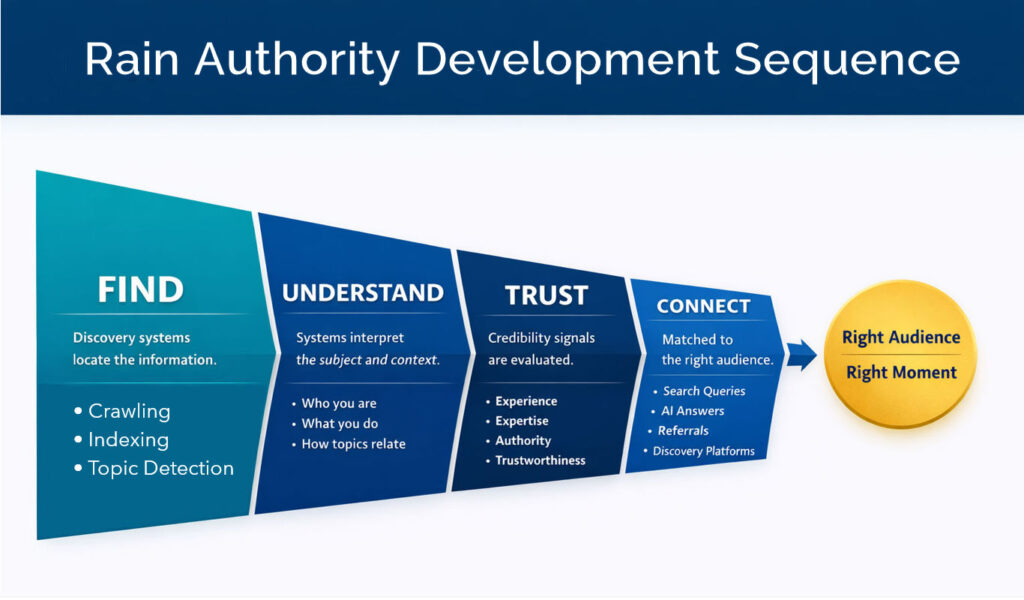
Find → Understand → Trust → Connect
Timing Advantage determines whether this sequence can begin and progress when it matters.
- If structure is not established before demand, Find may occur—but Understand fails
- If understanding cannot form quickly, or supporting signals are not present, Trust does not develop
- Without trust, connection does not occur
Each stage still depends on the one before it.
Progression is not assumed. It must be established, step by step.
Timing Advantage Determines Inclusion
Once a potential client enters the evaluation process:
- evaluation begins immediately
- comparisons are made quickly
- selections are narrowed without delay
At that point:
- incomplete systems are bypassed
- unclear information is ignored
- fragmented content is not reconciled
The system moves on.
What Is Rewarded?
When Structured Authority is in place:
- information is comprehensive, structured, and connected
- a clear, reliable understanding forms
- the process moves toward clarity and alignment
Are you prepared?
The Timing Advantage is right now.
The system does not wait.
The Shift Required
Timing Advantage is not the result of more content, more links, or more activity.
It is the strength of Structured Authority when the system arrives.
It is the result of structure already in place:
- entities clearly defined
- topics and relationships deliberately organized
- language aligned across content
- signals reinforced across onsite and offsite sources
When the system engages your Structured Authority and presents it at the right moment, alignment occurs.
A person searching for help with a matter of consequence is introduced to clear, relevant understanding based on your experience and legal skill.
That alignment establishes trust.
And trust leads to connection.
Why This Matters
Most firms focus on visibility around individual searches or topics.
If Structured Authority is not in place when the system arrives:
- visibility does not create understanding
- understanding does not create trust
- trust does not lead to connection
The opportunity to attract a new client is missed.
The issue is not exposure.
It is guided progression.
Each step of the sequence must be intentionally structured so the process is guided forward toward a decision.
Alignment.
Connection.
A new client.
A Clear Outcome
When Timing Advantage is established:
- the firm is immediately understandable
- credibility is recognized without delay
- and it is connected to the right opportunities
This is not a single result.
It is a consistent outcome.
Most firms are not missing opportunity because of a lack of experience or legal skill.
They are missing it because that experience is not clearly structured, understood, and trusted when it is evaluated.
You are either ready when encountered, or you are excluded.
If your firm is not consistently being found, understood, and selected for the matters
it is built to handle, the issue is not visibility.
It is structure.