
Why Legal Expertise Is Often Present — But Not Understood, Trusted, or Chosen
Legal expertise can be present, accurate, and well-earned—yet still remain unseen in any meaningful way. If that expertise is not structured so modern systems can interpret it, it is not understood, not trusted, and not used. When that happens, the right attorney is never considered at the moment a decision is made.
Structural visibility determines whether your experience and legal skill can be recognized and relied upon when it matters.
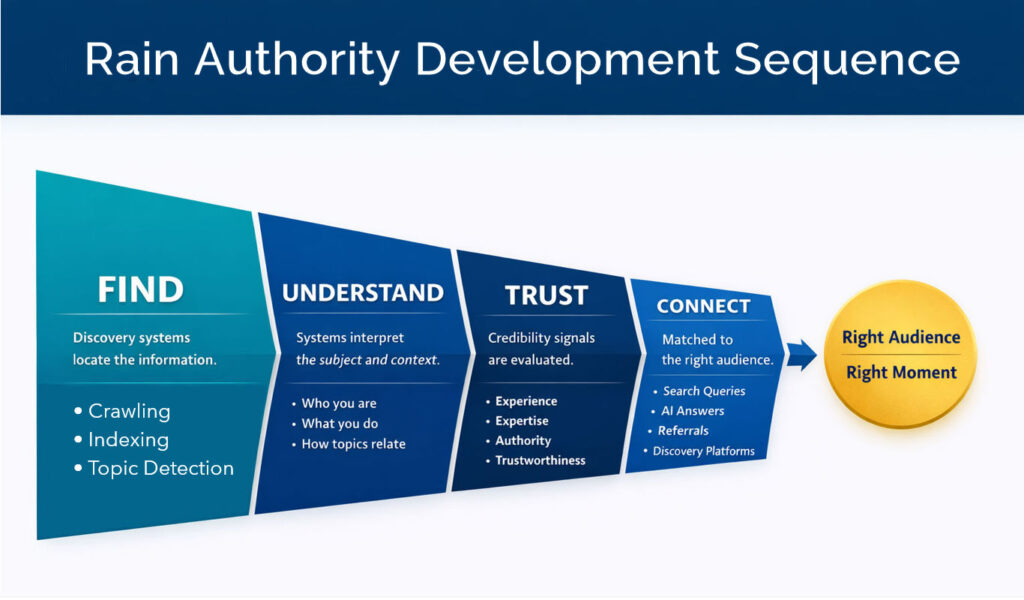 What Structural Visibility Means
Structural visibility is the ability of your experience and legal skill to move through the full decision sequence:
Find → Understand → Trust → Connect
Each stage builds on the one before it:
- If you are not found, nothing else happens
- If you are found but not clearly understood, evaluation stops
- If understanding is incomplete, trust does not form
- Without trust, connection does not occur
Most firms focus on being found.
Very few ensure they are understood.
Why Strong Firms Remain Invisible
 Many law firms have:
- substantial experience
- well-written pages
- long-standing reputations
Yet they are not consistently found, referenced or selected in modern discovery environments.
The issue is not capability.
It is structure.
Common patterns include:
- practice areas that exist without clear internal relationships
- supporting pages that do not reinforce a central topic
- content developed independently rather than as part of a system
- inconsistent language across related issues
In each case, the information exists—but it cannot be assembled into a clear, reliable understanding.
How Systems Evaluate Legal Expertise Now
 Modern discovery systems do not evaluate a single page in isolation.
They:
- scan across related topics
- compare how issues are explained
- look for consistency in language and structure
- determine whether a subject is fully developed or partially addressed
They are not searching for content.
They are processing information in order to understand it.
If your information does not support that process, it is not used—regardless of how accurate or well-written it may be.
Where Structural Visibility Breaks Down
Structural visibility is most often lost at the point of understanding.
A firm may be found, but:
- the scope of its work is unclear
- related issues are not connected
- supporting content does not reinforce the main topic
- key concepts are described inconsistently
The system cannot form a complete picture.
When a complete picture cannot be formed, the process stops before trust is established.
What Structural Visibility Requires
Structural visibility is not created by adding more content. It is created by organizing what already exists so it can be clearly interpreted.
 This requires:
Defined Primary Topics
Each core practice area must serve as a central reference point of understanding, not just a standalone page. The system will use these reference points to understand an entire topic with confidence.
Connected Supporting Content
Related issues must reinforce the primary topic by showing how concepts relate to and build on each other.
Consistent Language
Key ideas must be described consistently across pages so systems can recognize alignment and continuity.
Clear Relationships
Content must demonstrate how issues connect:
- cause and effect
- sequence
- dependency
- escalation
Without these relationships, information remains isolated and incomplete.
What Happens When Structure Is Missing
 When structural visibility is not established:
- legal skill and expertise exists but is not assembled
- content is present but not connected
- pages compete rather than reinforce each other
- systems cannot confidently interpret scope or depth
The result is predictable:
Your information is not selected for visibility when someone is deciding what to do next.
When Structure Is Missing
Information can exist in large volume and still fail to create understanding. When structure is missing, content does not organize into a clear system. It fragments.
At that point, the issue is not visibility. It is interpretability.
Structural Visibility and the Moment of Decision
Visibility is not simply about being present.
It is about being valuable and engageable at the moment someone moves from research to evaluation.
At that point, systems prioritize:
- clarity
- completeness
- consistency
- confidence
If your information cannot be quickly assembled into a reliable understanding, it is bypassed—regardless of how strong the underlying work may be.
How Structural Visibility Supports the Right Outcome
 When structure is correct:
- your experience becomes understandable from multiple entry points
- related issues reinforce each other
- systems can assemble a complete picture of your work
- your information is more likely to be presented at the moment it matters
This is not about increasing visibility through volume.
It is about ensuring your expertise can be understood, trusted, and used.
Where Structural Visibility Fits
Structural visibility is one part of a larger system.
It connects directly to:
- The Fragmentation Problem — when structure is missing, information becomes disconnected
- The Authority Sequence — how systems move from finding information to trusting it
- Timing Advantage — why structure must exist before demand appears
Each of these builds on the same principle:
Clarity and structure determine whether expertise is ever fully recognized.

A Stable Position Going Forward
Most firms do not have a visibility problem.
They have a structural problem.
When structure is corrected, visibility follows—not as a tactic, but as a result of being understood.
That shift changes not just how often your firm is seen, but whether it is considered at all.