
Why These Truths Matter
 Most legal marketing was built for a search environment that no longer fully exists.
For years, search visibility depended heavily on individual pages, keywords, backlinks, and publication volume. Search algorithms primarily evaluated documents in relative isolation, attempting to determine which page appeared most relevant to a particular query.
That environment has already undergone substantial algorithmic transformation and is rapidly giving way to far more interpretive discovery systems.
Modern search systems increasingly evaluate topics contextually across an entire digital environment. Instead of analyzing a single page alone, they interpret how information and pages intersect and relate, whether associated concepts reinforce one another, how consistently a subject is explained across a site, and whether the broader body of information appears coherent, trustworthy, and credible as a whole.
This shift fundamentally changes how legal visibility is created.
Search itself is also no longer the only primary pathway through which potential clients discover and evaluate attorneys. Visibility now exists within “The System” — modern discovery systems that include search engines, artificial intelligence systems, answer engines, recommendation systems, maps, directories, social platforms, and other interpretive technologies that increasingly organize, summarize, evaluate, and present information before a potential client ever reaches a website.
The 10 Truths of Structured Authority explain the consequences of this transformation, why traditional visibility alone is no longer enough, and how law firms handling matters of consequence must structure their experience and legal skill so they can be found, understood, trusted, and connected at the moment it matters.
Firms that intend to remain visible within “The System” cannot continue relying on websites built primarily for older search environments.
Their digital infrastructure must be fundamentally restructured — conceptually, architecturally, technically, and strategically — so modern discovery systems can interpret, trust, reinforce, and connect their experience and legal skill within increasingly sophisticated visibility environments.
The 10 Truths of Structured Authority
 Search Is No Longer Primarily Navigational
- Modern Visibility Depends on Interpretation
- Visibility Without Trust Creates Poor-Fit Inquiries
- The Best Clients Often Decide Before Contact
- Authority Must Be Structured To Become a Trusted Source
- Websites Must Become Guided Decision Environments
- The New Currency of Visibility Is Guided Insight
- Fragmented Information Weakens Trust and Visibility
- The Goal Is Not Traffic. The Goal Is New Clients.
- The Right Clients Must First Recognize the Right Attorney
Truth 1
Search Is No Longer Primarily Navigational
 This is the root truth.
Everything else flows from this.
For years, search functioned primarily as a navigational system.
A user entered a query.
Search engines returned a list of links.
The user manually browsed websites, compared options, reviewed pages, and attempted to determine which source appeared most credible, relevant, and trustworthy.
That behavior is rapidly changing.
Modern discovery systems increasingly attempt to answer questions, summarize information, interpret intent, organize knowledge, and guide users toward conclusions before a potential client ever visits a website.
Increasingly, the search itself becomes the destination.
The system now attempts to determine:
- what information appears most trustworthy
- which explanations are most coherent
- which sources appear most authoritative
and which organizations are most closely associated with a particular subject, problem, service, or outcome
 This fundamentally changes how legal visibility is formed.
In older search environments, visibility often depended heavily on ranking position and click-through behavior.
Within modern discovery environments, visibility increasingly depends on whether legal experience and skill are clearly structured so they can be interpreted, reinforced, trusted, summarized, and connected across an increasingly complex information ecosystem.
This is why isolated pages, disconnected content, generic articles, and traditional publication strategies are steadily losing effectiveness.
The system no longer evaluates visibility primarily through the existence of content alone.
- It increasingly evaluates:
- contextual relationships
- topical reinforcement
- credibility
- consistency
- structured understanding
- and trust formation across the broader digital environment
This is the foundational shift that gave rise to Structured Authority.
Summary
 For years, legal websites were built around highly keyworded individual documents. Each page became a separate opportunity to rank, supported by internal links, inbound links, and repeated topical signals.
The model was built one piece of the puzzle at a time.
That approach worked when search systems primarily evaluated documents, links, and page-level relevance.
It is no longer enough in an environment where modern discovery systems increasingly interpret the whole picture.
Truth 2
Modern Visibility Depends on Interpretation
Visibility is no longer determined primarily by the existence of content alone.
Modern discovery systems increasingly interpret information before deciding whether it should be indexed, summarized, trusted, reinforced, or presented to a potential client.
This is a fundamental shift.
 Older search environments focused heavily on:
- keywords
- page relevance
- backlinks
- publication volume
- and isolated ranking signals
Modern interpretive systems increasingly evaluate:
- contextual relationships between topics
- reinforcement across related content
- consistency of explanation
- structured understanding
- credibility signals
- trustworthiness
- topical depth
- and whether information appears coherent and genuinely useful as a whole
In other words, modern visibility increasingly depends on interpretation.
 This changes how legal authority is established.
Experience and legal skill are no longer evaluated primarily through isolated pages or individual articles. They are increasingly interpreted through the broader relationships surrounding the information itself.
Discovery systems now attempt to determine:
- whether a firm appears consistently associated with a subject
- whether related concepts reinforce one another
- whether explanations appear trustworthy and complete
- and whether the broader body of information demonstrates clarity, consistency, and authority across the digital environment
This is why Structured Authority now matters so profoundly.
Without structure:
- information becomes fragmented
- topics become disconnected
- authority signals weaken
- trust formation deteriorates
- and visibility becomes inconsistent
Modern visibility is increasingly shaped by whether a system can confidently interpret the whole picture.
Summary
Visibility no longer depends primarily on the existence of information alone.
It increasingly depends on whether modern discovery systems can interpret, reinforce, trust, and connect that information within a larger contextual framework.
Truth 3
Visibility Without Trust Creates Poor-Fit Inquiries
Visibility alone does not create strong client relationships.
 In matters of consequence, visibility without trust, contextual understanding, and alignment often produces poor-fit inquiries instead.
Many firms still measure success primarily through:
- traffic
- rankings
- impressions
- and inquiry volume
But increased visibility does not necessarily mean a potential client:
- understands the seriousness of their situation
- recognizes the importance of timing
- trusts the attorney
- values experience and legal skill
- or aligns with the firm’s approach and capabilities
As a result, firms often generate:
- low-trust consultations
- transactional shopping behavior
- poor-fit inquiries
and prospects who remain fundamentally unprepared for the realities of the matter itself

This is why Guided Insight matters.
The strongest inquiries are rarely created through visibility alone.
They occur when a potential client:
- understands the significance of their situation
- recognizes the importance of experienced legal counsel
- develops trust
and sees clear alignment between their problem and the attorney’s capabilities
The goal is not maximum visibility.
The goal is meaningful visibility to the right potential clients at the moment it matters.
Summary
Visibility without trust often increases poor-fit inquiries rather than strong client relationships.
Modern legal visibility must help the right potential clients understand, trust, align, and connect before contact ever begins.
Truth 4
The Best Clients Often Decide Before Contact
 In matters of consequence, many of the strongest potential clients begin evaluating attorneys long before direct contact ever occurs.
They spend time:
- researching
- comparing
- interpreting information
- evaluating trust
and attempting to understand the seriousness of their situation before deciding whether to contact legal counsel
During that process, trust often begins forming before a conversation with an attorney ever takes place.
This is one of the most important changes within modern legal visibility.
Rain Marketing’s Decision Standard is designed to enhance and accelerate this process. We interrupt the browsing mentality and engage visitors where they are, then guide them through that period of uncertainty — helping potential clients move from confusion and concern toward clarity, understanding, trust, alignment, and connection.
The firms most likely to attract strong matters are increasingly those that help potential clients recognize:
- the significance of their situation
- the importance of timing
- and the value of experienced legal counsel
before contact ever begins.
Summary
Many of the best potential clients begin making decisions before contacting an attorney.
Modern legal visibility increasingly depends on whether a firm can help potential clients develop trust, understanding, alignment, and the confidence to take action before direct communication ever occurs.
Truth 5
Authority Must Be Structured To Become a Trusted Source
Experience alone does not automatically create visible authority within modern discovery systems.
Professional experience and legal skill must be clearly organized, reinforced, connected, and consistently expressed across a broader digital environment before modern systems can reliably interpret, trust, and associate that authority with a particular subject, service, or type of matter.
This is one of the most important shifts in modern legal visibility.
Many highly capable attorneys remain difficult to distinguish online because their knowledge, experience, services, explanations, media, and related signals exist in fragmented or disconnected forms.
The issue is rarely capability.
The issue is structure.
Modern discovery systems increasingly evaluate:
- relationships between topics
- reinforcement across connected information
- consistency of explanation
- contextual alignment
- trust signals
and whether the broader body of information appears coherent and authoritative as a whole
This is why authority must now be deliberately structured.
Not manufactured.
Not exaggerated.
Structured.
This is the foundation of Structured Authority.
Summary
Modern authority is no longer created through visibility alone.
Professional experience and legal skill must be consistently structured, reinforced, and contextually connected before modern discovery systems can reliably interpret them as trustworthy authority.
Truth 6
Websites Must Become Guided Decision Environments
Traditional legal websites were largely built to store information.

Modern legal websites must now help guide human decision-making.
This is a fundamental shift.
In matters of consequence, potential clients often arrive:
- uncertain
- overwhelmed
- emotionally distracted
- concerned
and attempting to understand what is happening before avoidable mistakes occur
Most legal websites still operate as passive information repositories.
They present:
- isolated pages
- disconnected articles
- generalized explanations
- practice area descriptions
- and fragmented navigation paths
In many cases, the experience is centered almost entirely on the law firm and the law itself rather than the visitor’s position, uncertainty, timing, risks, and decision process.
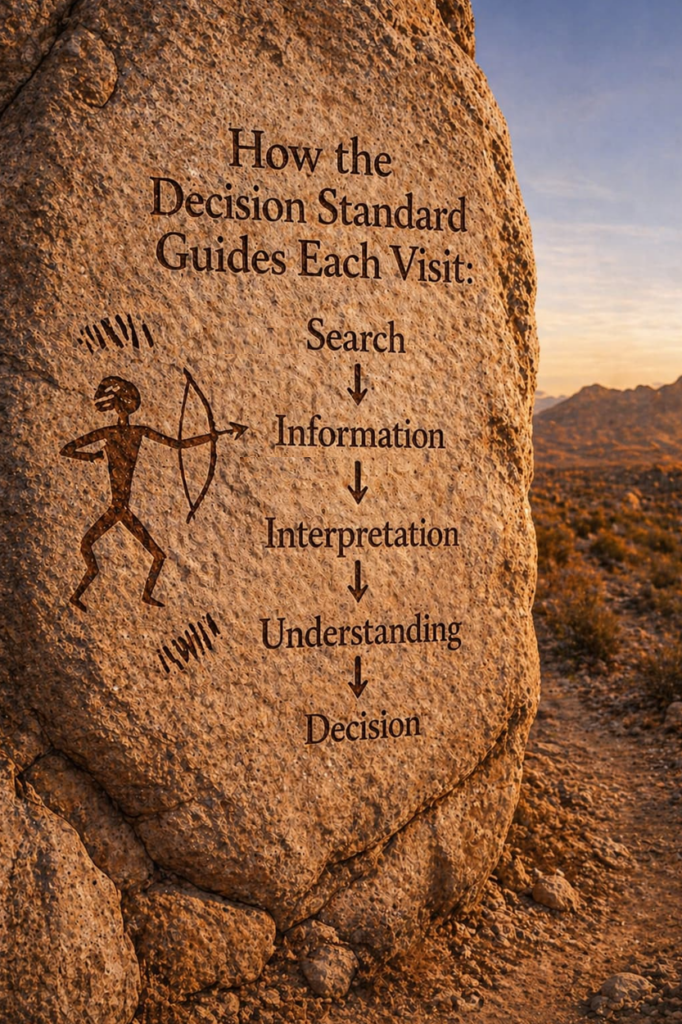 The Rain Decision Standard is designed to change that.
It helps potential clients:
- interrupt their browsing state
- determine where they are within their challenge or opportunity
- recognize the seriousness of their situation
- understand the importance of timing
- identify risks and avoidable mistakes
- develop trust
- understand why experienced legal counsel matters
- and confidently determine what should happen next
The objective is not merely to provide information.
It is to help potential clients reach a point where they feel informed, aligned, and comfortable taking the next step — whether through chat, text, a contact form, or a direct phone call.
Summary
Modern legal websites can no longer function primarily as passive collections of information.
They must increasingly guide understanding, reduce uncertainty, build trust, and help potential clients move confidently toward connection and action.
Truth 7
The New Currency of Visibility Is Guided Insight

Modern legal visibility is no longer determined primarily by the volume of information published online.
Increasingly, visibility is shaped by a firm’s ability to help potential clients:
- understand their situation
- recognize the importance of timing
- develop trust
- orient themselves within uncertainty
- and feel confident taking the next step
This is the foundation of Guided Insight.
Guided Insight is the structured process through which potential clients move from confusion and concern toward clarity, understanding, trust, alignment, and connection before a conversation with an attorney ever begins.
This is one of the most important shifts in modern legal visibility.
The firms most likely to gain traction within modern discovery systems are increasingly those that:
 answer real questions clearly
- connect related concepts coherently
- anticipate uncertainty
- reinforce understanding
and guide visitors through a structured decision process rather than simply presenting isolated information.
Modern discovery systems increasingly reward environments that appear genuinely useful, contextually connected, trustworthy, and aligned with user intent.
This is why Guided Insight is becoming one of the most valuable forms of modern legal visibility.
The objective is no longer simply to attract attention.
The objective is to help the right potential clients understand why experienced legal counsel matters before avoidable decisions shape outcome.
Summary
The new currency of modern legal visibility is not merely information.
It is Guided Insight — the ability to help potential clients develop understanding, trust, alignment, and the confidence to take meaningful action before contact ever begins.
Truth 8
Fragmented Information Weakens Trust and Visibility
Modern discovery systems increasingly evaluate legal information as part of a broader connected environment rather than as isolated pages alone.
When related information is fragmented, disconnected, inconsistent, repetitive, poorly organized, or weakly reinforced, both trust formation and visibility begin to deteriorate.
 This is one of the most common structural problems affecting legal websites today.
Many firms publish:
- disconnected articles
- isolated practice area pages
- overlapping explanations
- repetitive content
- and unrelated information pathways that fail to reinforce one another coherently
As fragmentation increases:
- contextual understanding weakens
- authority signals become diluted
- trust formation deteriorates
- user orientation declines
- and visibility becomes increasingly inconsistent
 Potential clients experience this fragmentation as:
- confusion
- uncertainty
- lack of clarity
- weak differentiation
- and difficulty determining whether the attorney truly understands the problem they are facing
Modern discovery systems increasingly experience it similarly.
This is why structural coherence matters so profoundly within Structured Authority.
Related concepts, services, explanations, guidance, and trust signals must reinforce one another clearly across the broader digital environment.
The goal is not simply to publish more information.
The goal is to create connected understanding.
Summary
Fragmented information weakens both human trust formation and modern discovery visibility.
Modern legal authority increasingly depends on whether related information reinforces a coherent, trustworthy, and connected understanding across the broader digital environment.
Truth 9
The Goal Is Not Traffic. The Goal Is New Clients.
 Traffic alone is not a meaningful business outcome for law firms handling matters of consequence.
A “visit” is merely a search event. Clicks are yet another metric;
What matters is whether the right potential clients:
- recognize the seriousness of their situation
- understand the importance of timing
- develop trust
- align with the attorney’s capabilities and connect with them personally
- and ultimately become qualified, paying clients
This is one of the most important distinctions within Structured Authority.
Many firms continue evaluating marketing performance primarily through:
- traffic volume
- impressions
- rankings
- clicks
- and generalized engagement metrics
But high traffic alone does not necessarily produce:
- strong matters
- aligned clients
- meaningful consultations
- or sustainable growth
In many cases, poorly aligned visibility produces the opposite.
The objective is not maximum attention.
 The objective is meaningful connection with the right potential clients at the moment experienced legal counsel matters most.
This is why Structured Authority focuses so heavily on:
- trust formation
- Guided Insight
- structural coherence
- contextual understanding
and helping potential clients recognize the significance of the moment they are in before avoidable mistakes shape outcome.
Summary
The objective of modern legal visibility is not traffic alone.
The objective is helping the right potential clients understand, trust, align, connect, and ultimately become strong new client relationships.
Truth 10
The Right Clients Must First Recognize the Right Attorney
In matters of consequence, the greatest challenge is often not merely being visible.
 It is being recognized – for your experience in an area of law, your skill with protecting your client’s interests and accomplishing their goals, as well as your ability to connect with clients and where they are in the moment.
Potential clients facing serious legal challenges frequently begin in uncertainty. They may not fully understand:
- the seriousness of their situation
- the risks surrounding communication and timing
- the consequences of action or inaction
- or the importance of experienced legal counsel during the earliest stages of a matter
Before a meaningful attorney-client relationship can begin, the right potential client must first recognize:
- that their situation requires experienced legal guidance
- that timing matters
- that not all attorneys are the same
- and that the right attorney may significantly shape outcome long before formal proceedings ever begin
 This is one of the central purposes of Structured Authority and Guided Insight.
The objective is not simply to increase visibility.
The objective is to help the right potential clients:
- recognize the significance of the moment they are in
- understand why experienced legal counsel matters
- develop trust and alignment
- and confidently take the next step before avoidable mistakes shape outcome
When that occurs, visibility becomes far more meaningful.
It becomes connection.
Summary
Before the right attorney can be chosen, the right potential client must first recognize the importance of experienced legal counsel, understand the significance of their situation, and feel confident taking the next step.
This is the ultimate purpose of Structured Authority, Guided Insight, and the Rain Marketing Decision Standard.
Structured Authority Is Anchored in the Truth of Change
We are often asked: “What changed?”
The answer is simple:
Everything.
 The vast majority of law firms are still operating as though the system never changed.
Many legal websites remain structured primarily around the law firm itself — its services, practice areas, accomplishments, and generalized legal information.
But the focus and structure required of modern legal visibility have fundamentally changed.
Modern discovery systems — and the potential clients using them — increasingly evaluate information from the perspective of the client, the matter of consequence they are facing, the risks surrounding timing and decision-making, and whether a firm’s experience and legal skill appear capable of helping them navigate what happens next.
This is one of the central principles of Structured Authority.
The objective is no longer simply to describe the law firm.
The objective is to help the right potential clients recognize:
- the seriousness of their situation
- the importance of timing
- the value of experienced legal counsel
- and why your experience and legal skill may matter before avoidable decisions shape outcome
 The supporting structure required to compete within modern discovery environments has also fundamentally changed.
For years, legal visibility depended heavily on:
- inbound links
- publication frequency
- isolated pages
- keyword targeting
- and document-level optimization
Those signals still exist, but they no longer operate with the same influence they once did.
The algorithms of major search engines have already undergone measurable and material shifts in how information is evaluated, trusted, summarized, reinforced, and integrated across broader digital environments.
The influence of those assets has already diminished substantially and will continue declining as modern discovery systems increasingly prioritize contextual understanding, structural coherence, reinforcement, trust formation, and connected interpretation across broader digital environments.
Modern discovery systems increasingly evaluate:
- broader contextual relationships
- structural coherence
- topical reinforcement
- trust signals
- guidance quality
- and whether legal information appears genuinely useful, connected, and trustworthy as a whole
This is one of the reasons Structured Authority matters so profoundly.
 Structured Authority aligns a law firm’s digital infrastructure with the language, signals, relationships, and trust mechanisms increasingly valued by both modern discovery systems and potential clients themselves.
The direction of this transformation is increasingly clear.
Modern discovery systems are steadily moving away from:
- isolated documents
- disconnected pages
- generalized legal information
- and fragmented publication strategies
They are increasingly moving toward:
- connected understanding
- interpretive trust formation
- structural reinforcement
- Guided Insight
 and systems capable of identifying which information appears most coherent, trustworthy, authoritative, and genuinely useful within the broader context surrounding a subject or matter of consequence
This is the environment now taking shape.
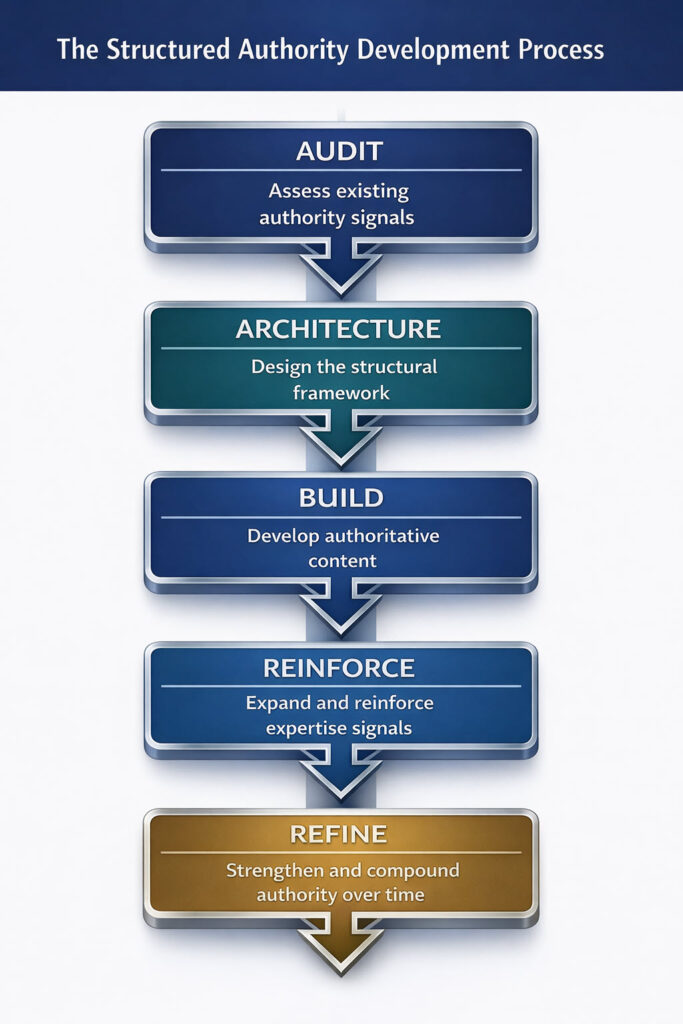
Structured Authority is Rain Marketing’s response to that transformation.
It is a framework designed to help law firms handling matters of consequence structure their experience and legal skill so they can be found, understood, trusted, and connected at the moment it matters most.
And increasingly, that moment occurs long before a potential client ever contacts an attorney.