
What Changed?
A search on the internet, whether in a search engine or AI, begins because something happened.
If you don’t understand what happened to the person before they searched, you’ll organize the information around the wrong thing.
 Each page in this new information ecosystem must ask and answer several questions. The primary question today is this: “What does this person need to understand, at this moment in time, in order to make a good decision?“
The central question we must ask ourselves is quite different: “What is required to move our potential client from where they are at this moment, to the point where they stop searching for more information and feel comfortable enough and connected enough to reach out?“
The commodity of the old system – primarily search engines – was the optimized document, and its associated keyword strings.
The commodity of the new information ecosystem is the ability to answer the question(s) of the person encountering the screen in front of them, and to guide them from the challenges or objectives of where they are to a position of understanding.
Accomplishing this task requires more than individual pages. This requires an integrated system, intentionally designed to meet the potential client where they are at any moment in time and not only begin to answer the questions they have now, but anticipate the questions that naturally follow, and guide them through a process of understanding, while demonstrating thorough expertise that can be found, understood, trusted, integrated, and delivered in response to virtually any question on the subject.
It’s a new world.

What This Means For Your Law Practice
Question
What has changed?
Answer
In a word: Everything.
The internet increasingly interprets, evaluates, and synthesizes information before presenting answers to potential clients.
Modern systems do not simply locate pages. They assess relevance, context, trustworthiness, and alignment with the intent behind a question or request.
Question
Why does this matter for your law practice?
Answer
Because visibility now depends not only on whether information exists, but whether experience and legal skill are structured clearly enough to become trusted sources within modern discovery systems.
Those systems increasingly evaluate relevance, context, trustworthiness, and alignment before presenting information in response to an inquiry from a potential client.
Question
What is the goal in this new environment?
Answer
The goal is not clicks or traffic alone. The goal is trusted connection between the right attorney and the right client.
This moves the visitor from confusion and uncertainty to clarity, understanding, and confidence to take the next step.





A Long, Successful Journey Meets an Unexpected Wall of Change

For more than twenty-five years, you and I have been on the same journey. While I haven't practiced law myself, I have dedicated my career to one mission: helping exceptional attorneys be found by those who needed their experience, their judgment, and the legal skill to guide them through some of the most important decisions of their lives.
Together, we've watched search evolve from a simple directory of websites into the primary way prospective clients found legal counsel. Together, we've learned each new lesson, adapted to each new algorithm, and implemented each new recommendation because, quite frankly, it worked.
For years, those efforts continued to produce exactly what we expected. Prospective clients found us. Qualified inquiries followed. New client relationships were formed. While search engines continued to evolve, each new recommendation felt like a natural extension of the last. We adapted, refined, improved, and continued moving forward with confidence because experience had taught us that doing so would be rewarded.
Then, during the spring and summer of 2025, something fundamentally changed.
There was no announcement. No handbook. No conference presentation explaining what was happening. The strategies that had guided us for years didn't suddenly become wrong, but they no longer explained the world we were now working in. For the first time in decades, many attorneys—and many of those of us who had spent our careers helping them—found ourselves asking the same question:
Why doesn't that work as effectively any longer?
Because today's search environment is no longer evaluating pages as isolated resources. It is increasingly evaluating understanding, context, relationships, and confidence across an entire body of information. While individual pages still matter, they are no longer the primary unit of evaluation they once were.
A website organized primarily around the practice assumes the visitor begins by understanding the law, the legal issue, or the legal service they need.

Here is perhaps the most important thing you need to know.
Your best prospective clients aren't thinking about hiring an attorney yet.
They are focused on their own unique situation. They are focused on the opportunity or challenge in front of them, and they are trying to understand not only what has happened, but what they should do next.
That is where you must meet them.
They begin with a situation. They search for understanding. Their questions evolve. Their confidence develops. Only then do they begin evaluating attorneys.
Their search journey most often begins with a specific situation. They search for understanding. Their questions evolve. They aren't seeking to hire an attorney, they're trying to get their feet back under them and understand not only where they stand, but what to do next.
Meet them where they are.
Guide them.
Help them to understand not only where they are, but the steps they can take to begin moving forward. Once you have provide the stewardship of meeting them where they are, helping them to reorient themselves to the change that surrounds them, and provide a bit of hope and an idea of what comes next, you are in a position to extend your hand.
They need to understand where they stand. They need to understand there are steps they should take, communications they should send, and many they should not. They need to understand the greatest risks they face and the highest probability of affecting a positive outcome isn't down the road, or even in a courtroom. It is right now.
THAT understanding, that insight not only helps to reorient them, it builds a bridge of confidence and trust between that visitor and your practice. They are in a position to accept that offer. And the trust underlying that connection, is the foundation of a likely successful relationship.
The attorney's role is no longer simply to describe the law. It is to represent the searcher's progression from uncertainty to understanding.




Visibility Now Depends on Interpretation by “The System”
 The traditional search environment was largely built around keyword-focused documents. More pages often meant more opportunities for visibility.
Modern discovery systems no longer evaluate isolated “pieces of the puzzle.”
They increasingly interpret the entire picture:
the relationships between connected topics, the consistency of information, the depth of your relevant experience and legal skill, and the ability of your site to guide understanding through a series of connected questions and concerns.
As a result, search engines, AI systems, and modern discovery platforms now evaluate websites from a fundamentally different perspective before presenting information to potential clients.
They do not simply locate pages.
They increasingly interpret:
- relevance
- context
- trustworthiness
- relevant experience and legal skill
- relationships between topics
- consistency across sources
- alignment with the intent behind a search or inquiry
Visibility no longer depends solely on whether information exists, proper keywording, or inbound linking strategies.
The ability to be selected by the system and presented to a potential client now depends on whether the experience and legal skill of your law practice are structured clearly enough to become trusted sources within modern discovery systems.
Potential clients increasingly arrive with a clearer understanding of their situation before ever contacting an attorney. Many initial questions are answered within “The System” — modern information environments — long before a conversation begins.
 In many ways, this improves the quality of engagement. Fewer casual inquiries reach the office. The conversations that do occur are often more informed, more focused, and more likely to become meaningful matters.
But many law firm websites were never structured for systems that interpret, evaluate, and synthesize information before presenting it to a potential client.
As a result, capable firms often experience:
- inconsistent visibility
- reduced engagement
- unpredictable inquiry flow
- difficulty distinguishing their experience and legal skill within increasingly complex discovery environments
The issue is rarely effort.
It is structure.
Without Structured Authority, information becomes fragmented and difficult for modern systems to interpret, trust, and connect to the right inquiry at the right moment.
Visibility ≠ Opportunity
Visibility alone no longer produces meaningful client engagements.
What matters is whether your experience and legal skill are clearly understood by “The System,” trusted, and presented at the moment a potential client is working to understand where they stand, the risks they face, whether legal counsel is needed, and which attorney may be best suited to help them.
If that does not occur, visibility does not translate into opportunity.
What This Means
Visibility is no longer driven by activity alone.
It depends on how clearly your experience and legal skill are structured—so they can be found, understood, trusted, and connected to the right client at the right moment.
We refer to this structured process—how a potential client experiences guidance, context, and connected understanding within a Structured Authority environment—as Guided Insight. Its purpose is to help potential clients move from confusion and concern toward clarity, trust, alignment, and informed decision-making before a conversation with an attorney ever begins.
Why Structured Authority Increases the Flow of New Opportunities
A Potential Client Must Understand the Need for Experienced Legal Counsel — or They Simply Browse On
Structured Authority helps potential clients recognize the significance of the moment they are in.
In matters of consequence, the greatest risks are often not created inside a negotiation, courtroom, mediation, arbitration, or trial itself.
They are shaped during the earliest stages of uncertainty—before a person fully understands their position, their exposure, the implications of communication, or the consequences of action and inaction.
In matters such as:
- business disputes
- complex family law
- tax controversy
- partnership and shareholder conflicts
- mergers and acquisitions
- fiduciary disputes
- investigations and potential criminal exposure
- high-stakes litigation
small early decisions can significantly alter:
- leverage
- financial recovery
- exposure and potential damages
- documentation and chronology
- credibility
- defensibility
- negotiation strength
- settlement posture
- procedural position
- timing advantage
In many matters of consequence, the greatest opportunity to protect position, reduce risk, preserve leverage, and improve outcome exists before formal proceedings ever begin.
 Before:
- positions harden
- narratives solidify
- filings occur
- deadlines pass
- communications escalate
- leverage shifts
- evidence changes
- exposure increases
- procedural constraints attach
That is often when experienced legal counsel is most valuable.
General information on your website should help someone begin to understand their situation.
But only experienced legal counsel can provide guidance specific to the facts, risks, timing, objectives, and consequences involved.
This is why Guided Insight exists within Structured Authority:
to help potential clients recognize the importance of informed legal guidance before avoidable decisions shape outcome.
Modern discovery systems evaluate information in stages.
They must:
- locate the information
- interpret its meaning and context
- verify credibility signals
- connect that expertise with the audience searching for it
Only information that moves successfully through that sequence is consistently presented when potential clients begin searching for answers.
Structured Authority is designed to ensure that a firm’s experience and legal skill are organized and reinforced so they can move clearly through that process.
By aligning knowledge across related topics—and supporting it with signals these systems can interpret—expertise becomes easier to:
- Find
- Understand
- Trust
- Connect with the right audience
This process can be visualized in a simple sequence:
Find → Understand → Trust → Connect
Authority is not created by a single action. It is built through structured reinforcement.
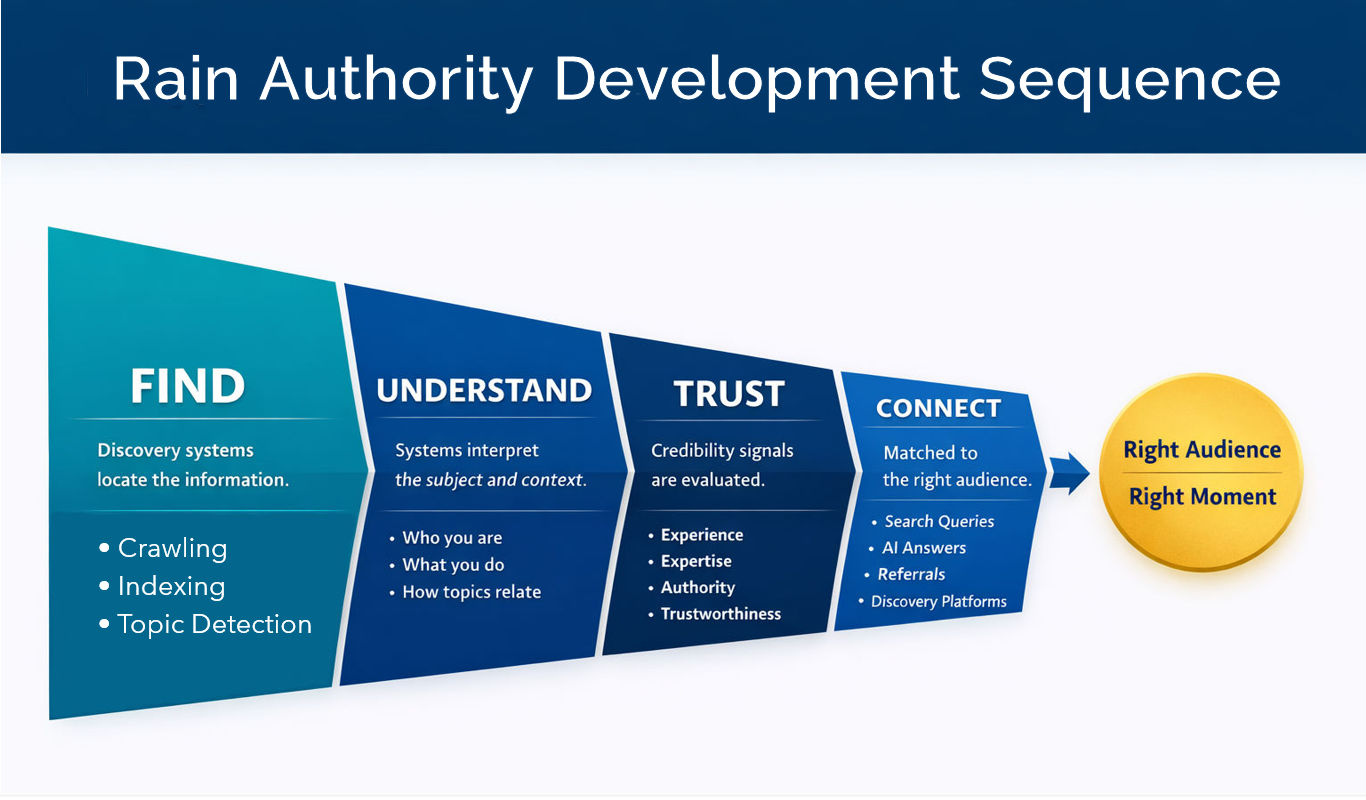
Each stage reinforces the next. If any step is unclear or unsupported, visibility becomes inconsistent.
When your firm’s experience and legal skill are clearly structured and reinforced across related topics, discovery systems are far more likely to:
- find your content
- understand what it means
- trust its credibility
- and connect it with the audience seeking it
Why This Matters
Information is not simply stored and displayed.
It is interpreted, evaluated and selected.
Visibility depends on how clearly your experience and legal skill can be understood and trusted within that process.
This is where structure begins to matter most.

 But the objective of structured authority marketing for law firms is not simply attention.
The objective is connection.
People with genuine problems are searching through an overwhelming stream of information. What they are really looking for is you.
What they are really searching for is clarity, direction, and someone they can trust.
When experience and legal skill are structured properly, it becomes easier for the right client to find the right attorney at the moment it matters.
That is the role of Structured Authority.
It is not about clicks or traffic alone.
The best cases do not come from volume.
They come from alignment.
This is how authority becomes visible at the moment it matters.
Rain Marketing + Consulting works with experienced attorneys handling matters where outcomes depend on judgment, credibility, and professional experience.
The focus is not visibility alone.
It is ensuring the right clients can find the right attorney—at the moment it matters.
Selective Representation
One Firm Per Practice Area Per Geographic Location (Market)
 Rain Marketing + Consulting
Rain works with only one firm per practice area within a defined geographic market.
This protects the integrity of each firm’s authority development and avoids conflicts created by representing competing firms in the same space.
The firm’s clients typically handle matters where the outcome depends heavily on experience, judgment, and professional credibility.
Who is Structured Authority Specifically Built For
Rain’s clients typically handle matters such as:
- complex litigation
- business conflicts and owner disputes (shareholders, members, partners, investors)
- complex family law matters
- sophisticated business transactions, including mergers and acquisitions
- tax controversy including IRS and state agency investigations, audits, and disputes, as well as international tax issues for expatriates and those with international business interests, investments, cryptocurrency and financial accounts
These are matters where experience, judgment, and credibility determine the outcome.
Why Clients Stay
That reflects the long-term nature of authority development—and the genuine value of building visibility that remains consistent over time.
Most Rain clients have worked with the firm for more than a decade.
Our clients value transparency.
Regularly scheduled strategic reviews are not centered on anonymous traffic volume. In high-stakes legal matters, a “visit” is merely a search event. What matters is the decision process that follows.
We measure success by the alignment of the inquiries you receive—and by the conversion of those inquiries into qualified, paying clients.
The objective is not visibility alone.
It is a sustainable flow of the specific matters your firm is best equipped to handle.
Experience and Credibility
Rain Marketing’s founder is also a two-time JD Supra Readers’ Choice Award recipient in the Tax category, reflecting sustained readership among legal professionals and business leaders.
Attorneys handling matters of consequence benefit from a structured approach to visibility.
If You Are Considering What Comes Next
At this point, most attorneys expect a sales process.
There is no sales process. The first step is a structured conversation focused on understanding your current position, and how your visibility is being experienced and interpreted by a visitor.
This conversation is intentionally limited to 20 minutes. At the nine-minute mark, we pause and ask a direct question:
Is this conversation of value, and do you wish to continue?
If the answer is no, the conversation ends.
No follow-up sequence. No continued outreach. A respectful conclusion.
If the answer is yes, the remaining time is used to gather the information needed to prepare a deep analysis of your current strategy, structure, and visibility.
Continue with the 20/9 Protocol
The 20/9 Protocol — A Conversation That Changes Things
Or Explore the Structure First
Explore Structured Authority
Rain Marketing + Consulting, Inc.
Structured Authority Marketing for Law Firms